

1. 調査手法および範囲
1.1. 調査手法
1.2. 調査目的およびレポートの範囲
2. 定義および概要
3. エグゼクティブサマリー
3.1. 製品種類別抜粋
3.2. 技術別抜粋
3.3. 処置の種類別抜粋
3.4. エンドユーザー別抜粋
4. 力学
4.1. 影響因子
4.1.1. 推進要因
4.1.1.1. 口腔疾患の負担増大と
4.1.1.2. XX
4.1.2. 阻害要因
4.1.2.1. 機器および治療費の高額さ
4.1.3. 機会
4.1.4. 影響分析
5. 産業分析
5.1. ポーターのファイブフォース分析
5.2. サプライチェーン分析
5.3. 価格分析
5.4. 規制分析
6. 製品種類別
6.1. はじめに
6.1.1. 製品種類別分析および前年比成長率(%)
6.1.2. 製品種類別市場魅力度指数
6.2. 一般および診断用機器*
6.2.1. はじめに
6.2.2. 市場規模分析および前年比成長率(%)
6.2.3. 歯科用レーザー
6.2.4. 放射線機器
6.2.5. 歯科用チェアおよび機器
6.2.6. その他
6.3. 歯科用消耗品
6.3.1. 歯科用生体材料
6.3.2. 歯科用インプラント
6.3.3. クラウンおよびブリッジ
6.3.4. その他
6.4. その他
7. 技術別
7.1. はじめに
7.1.1. 技術別市場規模分析および前年比成長率(%)
7.1.2. 技術別市場魅力度指数
7.2. デジタルソリューション*
7.2.1. はじめに
7.2.2. 市場規模分析および前年比成長率(%)
7.3. 先進イメージング技術
7.4. 遠隔歯科ソリューション
7.5. その他
8. 治療の種類別
8.1. はじめに
8.1.1. 市場規模分析および前年比成長率(%)、治療の種類別
8.1.2. 市場魅力度指数、治療の種類別
8.2. 矯正器具 *
8.2.1. はじめに
8.2.2. 市場規模分析および前年比成長率分析(%)
8.3. 歯内治療用器具
8.4. 歯周治療用器具
8.5. 補綴治療用器具
9. エンドユーザー別
9.1. はじめに
9.1.1. エンドユーザー別市場規模分析および前年比成長率分析(%)
9.1.2. 市場魅力度指数、エンドユーザー別
9.2. 病院 *
9.2.1. 概要
9.2.2. 市場規模分析および前年比成長率分析(%)
9.3. 歯科クリニック
9.4. その他
10. 競合状況
10.1. 競合シナリオ
10.2. 市場ポジショニング/シェア分析
10.3. 合併・買収分析
11. 企業プロフィール
Dentsply Sirona
3M
Takara Belmont
KaVo Dental
J. MORITA CORP.
MANI, INC.
GC Corporation
Nakanishi Inc. (NSK)
Ivoclar Vivadent
Ultradent Products Inc.
リストは完全なものではありません。
12. 付録
12.1. 当社およびサービスについて
12.2. お問い合わせ
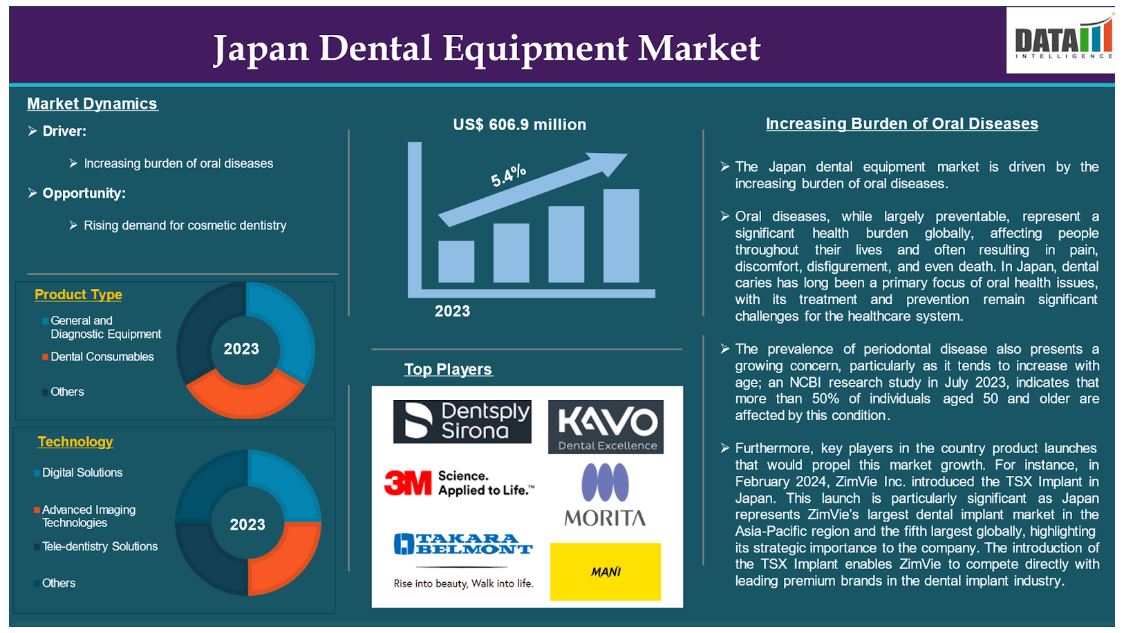
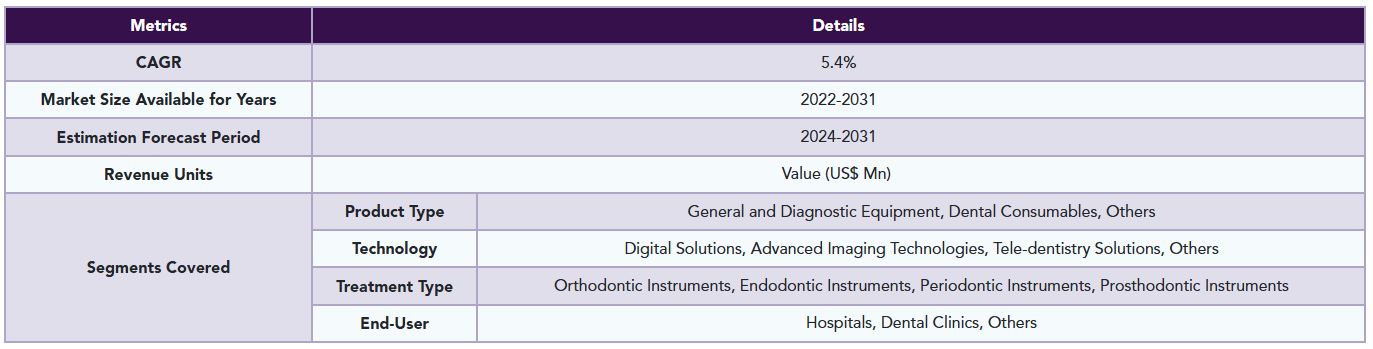
The Japan dental equipment market reached US$ 606.9 million in 2023 and is expected to reach US$ 924.2 million by 2031, growing at a CAGR of 5.4 % during the forecast period 2024-2031.
Dental equipment comprises a specialized collection of instruments utilized by oral surgeons and dental specialists to conduct a variety of procedures involving the mouth, jaw, and face. These procedures encompass tooth extractions, implant placements, bone grafting, and corrective jaw surgeries. The range of dental instruments includes scalpels and blades designed for precise incisions in gum tissue and bone, available in various shapes and sizes to meet specific treatment needs.
Dental equipment includes permanent fixtures commonly found in dental offices, such as chairs, lights, x-ray and imaging machines, lasers, compressors, vacuums, handpieces, and cabinets. These tools are vital for ensuring the effective delivery of dental care and maintaining healthy teeth and gums.
Furthermore, dental equipment encompasses utility systems that support the operation of a dental practice, including infection control protocols and setups for portable dental operatories. This equipment can be categorized into multiple types to cover the diverse needs of dental practices in treating patients effectively. These factors have driven the Japan dental equipment market expansion.
Market Dynamics: Drivers & Restraints
Increasing Burden of Oral Diseases
The increasing burden of oral diseases is significantly driving the growth of the Japan dental equipment market and is expected to drive throughout the market forecast period.
Oral diseases, while largely preventable, represent a significant health burden, affecting people throughout their lives and often resulting in pain, discomfort, disfigurement, and even death. In Japan, dental caries has long been a primary focus of oral health issues, with its treatment and prevention remain significant challenges for the healthcare system.
Despite improvements in dental care and public health initiatives, caries continue to affect a substantial portion of the population. The prevalence of periodontal disease also presents a growing concern, particularly as it tends to increase with age; an NCBI research study in July 2023, indicates that more than 50% of individuals aged 50 and older are affected by this condition.
Periodontal disease is characterized by chronic inflammation that can lead to tooth loss if left untreated. Unlike caries, which often causes noticeable pain as it progresses, periodontal disease may not present severe symptoms until significant damage has occurred, making it a "silent" disease. This lack of immediate discomfort can result in delayed diagnosis and treatment, further exacerbating the condition. Consequently, there is an urgent need for public health initiatives that not only continue to address caries but also shift focus towards preventing and managing periodontal disease, especially as Japan faces the challenges of an aging population.
Furthermore, key players' strategies such as partnerships and collaborations would propel this Japan dental equipment market. For instance, in November 2021, Singapore-based Zenyum, announced its expansion into Japan, marking its entry into the ninth market across Asia. This move is part of Zenyum's strategy to broaden its reach and capitalize on the growing demand for dental solutions in the region. The company has gained recognition as one of Asia's fastest-growing brands in the consumer dental sector and was named a LinkedIn Top Startup in 2021.
Also, in August 2021, Kyocera Corporation, led by President Hideo Tanimoto, announced a strategic partnership with Osteon Digital Japan Co., Ltd., headed by CEO Michael Tuckman. This collaboration focuses on continuous sales transactions and will commence the sale of customized dental prostheses for implants utilizing Osteon’s advanced digital technology.
This agreement is significant for Kyocera as it aims to enhance its presence in the dental implant market, particularly in Japan, which is a key region for dental innovations. By partnering with Osteon, Kyocera seeks to leverage Osteon’s expertise in digital solutions and CAD/CAM technology to improve its offerings in dental prosthetics. All these factors demand the Japan dental equipment market.
Moreover, the rising demand for cosmetic dentistry contributes to the Japan dental equipment market expansion.
High Equipment and Treatment Costs
The high costs associated with advanced dental equipment present a significant barrier for many dental practices in Japan, particularly for smaller clinics. Advanced technologies, such as digital imaging systems and lasers, require substantial financial investment, which can lead practitioners to postpone upgrades or choose less effective options, ultimately affecting the quality of care.
Additionally, dental insurance coverage in Japan is often limited; many advanced procedures are not fully reimbursed, forcing patients to pay a considerable portion of these expenses out-of-pocket. This financial burden can deter individuals from seeking necessary treatments, particularly elective or cosmetic procedures.
Expensive procedures and equipment can mean increased out-of-pocket expenses for patients. This may discourage patients from pursuing required dental surgery, reducing overall demand for the equipment utilized in those procedures. Smaller dental practices, particularly in low-income areas, may be hesitant to invest in expensive equipment due to concerns about return on investment. The high equipment and treatment costs will hinder the growth of Japan dental equipment market.
The prices of some dental X-ray instruments can be as low as 500 USD or less, while the newest, high-tier systems may cost as much as 100,000 USD. Thus, the above factors could be limiting the Japan dental equipment market's potential growth.
Segment Analysis
The Japan dental equipment market is segmented based on product type, technology, treatment type, and end-user.
Product Type:
The dental consumables segment is expected to dominate the Japan dental equipment market share
The dental consumables segment holds a major portion of the Japan dental equipment market share and is expected to continue to hold a significant portion of the Japan dental equipment market share during the forecast period.
Consumables in dentistry, such as drills, burs, scalpels, sutures, and barriers (drapes), are disposable items that require frequent repurchases by dental clinics. This creates a consistent and recurring revenue stream for manufacturers compared to capital equipment sales, which typically involve significant upfront costs for research, development, and production. In contrast, consumables generally have lower production costs and higher profit margins.
The consumable segment is continually evolving due to innovations in materials, design, and functionality. This ongoing cycle of innovation encourages dentists to adopt and utilize new consumables, contributing to market growth. As a result, these factors are expected to drive the growth of the consumable segment, which is anticipated to dominate the Japan dental equipment market share moving forward.
Furthermore, key players in the country product launches that would propel this segment's growth in the Japan dental equipment market. For instance, in February 2024, ZimVie Inc. introduced the TSX Implant in Japan. This launch is particularly significant as Japan represents ZimVie’s largest dental implant market in the Asia-Pacific region and the fifth largest globally, highlighting its strategic importance to the company. The introduction of the TSX Implant enables ZimVie to compete directly with leading premium brands in the dental implant industry. These factors have solidified the segment's position in the Japan dental equipment market.
Competitive Landscape
The major players in the Japan dental equipment market include Dentsply Sirona., 3M, Takara Belmont, KaVo Dental, J. MORITA CORP., MANI, INC., GC Corporation, Nakanishi Inc. (NSK), Ivoclar Vivadent, and Ultradent Products Inc. among others.
Emerging Players
The emerging players in the Japan dental equipment market include Imagoworks Inc., and Zenyum, among others.
Key Developments
• In January 2023, Imagoworks, a South Korean company specializing in digital dental solutions powered by artificial intelligence (AI), has recently announced a distribution agreement with Ci Medical, a dental supplier, to introduce its Dentbird Solutions software into the Japanese dental market. This partnership marks a significant step for Imagoworks as it expands its presence in Asia.
• In November 2022, NSK Ltd. introduced QuickStopBearing, an innovation designed for air turbine dental handpieces, which are commonly used instruments in dental practices worldwide. This development aims to enhance both the efficiency and safety of dental procedures, addressing critical needs in the dental industry.
Why Purchase the Report?
• Pipeline & Innovations: Reviews ongoing clinical trials, product pipelines, and forecasts upcoming advancements in medical devices and pharmaceuticals.
• Product Performance & Market Positioning: Analyzes product performance, market positioning, and growth potential to optimize strategies.
• Real-World Evidence: Integrates patient feedback and data into product development for improved outcomes.
• Physician Preferences & Health System Impact: Examines healthcare provider behaviors and the impact of health system mergers on adoption strategies.
• Market Updates & Industry Changes: Covers recent regulatory changes, new policies, and emerging technologies.
• Competitive Strategies: Analyzes competitor strategies, market share, and emerging players.
• Pricing & Market Access: Reviews pricing models, reimbursement trends, and market access strategies.
• Market Entry & Expansion: Identifies optimal strategies for entering new markets and partnerships.
• Regional Growth & Investment: Highlights high-growth regions and investment opportunities.
• Supply Chain Optimization: Assesses supply chain risks and distribution strategies for efficient product delivery.
• Sustainability & Regulatory Impact: Focuses on eco-friendly practices and evolving regulations in healthcare.
• Post-market Surveillance: Uses post-market data to enhance product safety and access.
• Pharmacoeconomics & Value-Based Pricing: Analyzes the shift to value-based pricing and data-driven decision-making in R&D.
The Japan dental equipment market report would provide approximately 42 tables, 33 figures, and 183 pages.
Target Audience 2023
• Manufacturers: Pharmaceutical, Medical Device, Biotech Companies, Contract Manufacturers, Distributors, Hospitals.
• Regulatory & Policy: Compliance Officers, Government, Health Economists, Market Access Specialists.
• Technology & Innovation: AI/Robotics Providers, R&D Professionals, Clinical Trial Managers, Pharmacovigilance Experts.
• Investors: Healthcare Investors, Venture Fund Investors, Pharma Marketing & Sales.
• Consulting & Advisory: Healthcare Consultants, Industry Associations, Analysts.
• Supply Chain: Distribution and Supply Chain Managers.
• Consumers & Advocacy: Patients, Advocacy Groups, Insurance Companies.
• Academic & Research: Academic Institutions.
1. Methodology and Scope
1.1. Research Methodology
1.2. Research Objective and Scope of the Report
2. Definition and Overview
3. Executive Summary
3.1. Snippet by Product Type
3.2. Snippet by Technology
3.3. Snippet by Treatment Type
3.4. Snippet by End-User
4. Dynamics
4.1. Impacting Factors
4.1.1. Drivers
4.1.1.1. Increasing Burden of Oral Diseases and
4.1.1.2. XX
4.1.2. Restraints
4.1.2.1. High Equipment and Treatment Costs
4.1.3. Opportunity
4.1.4. Impact Analysis
5. Industry Analysis
5.1. Porter’s Five Force Analysis
5.2. Supply Chain Analysis
5.3. Pricing Analysis
5.4. Regulatory Analysis
6. By Product Type
6.1. Introduction
6.1.1. Analysis and Y-o-Y Growth Analysis (%), By Product Type
6.1.2. Market Attractiveness Index, By Product Type
6.2. General and Diagnostic Equipment*
6.2.1. Introduction
6.2.2. Market Size Analysis and Y-o-Y Growth Analysis (%)
6.2.3. Dental Lasers
6.2.4. Radiology Equipment
6.2.5. Dental Chairs and Equipment
6.2.6. Others
6.3. Dental Consumables
6.3.1. Dental Biomaterials
6.3.2. Dental Implants
6.3.3. Crowns and Bridges
6.3.4. Others
6.4. Others
7. By Technology
7.1. Introduction
7.1.1. Market Size Analysis and Y-o-Y Growth Analysis (%), By Technology
7.1.2. Market Attractiveness Index, By Technology
7.2. Digital Solutions*
7.2.1. Introduction
7.2.2. Market Size Analysis and Y-o-Y Growth Analysis (%)
7.3. Advanced Imaging Technologies
7.4. Tele-dentistry Solutions
7.5. Others
8. By Treatment Type
8.1. Introduction
8.1.1. Market Size Analysis and Y-o-Y Growth Analysis (%), By Treatment Type
8.1.2. Market Attractiveness Index, By Treatment Type
8.2. Orthodontic Instruments *
8.2.1. Introduction
8.2.2. Market Size Analysis and Y-o-Y Growth Analysis (%)
8.3. Endodontic Instruments
8.4. Periodontic Instruments
8.5. Prosthodontic Instruments
9. By End-User
9.1. Introduction
9.1.1. Market Size Analysis and Y-o-Y Growth Analysis (%), By End-User
9.1.2. Market Attractiveness Index, By End-User
9.2. Hospitals *
9.2.1. Introduction
9.2.2. Market Size Analysis and Y-o-Y Growth Analysis (%)
9.3. Dental Clinics
9.4. Others
10. Competitive Landscape
10.1. Competitive Scenario
10.2. Market Positioning/Share Analysis
10.3. Mergers and Acquisitions Analysis
11. Company Profiles
11.1. Dentsply Sirona. *
11.1.1. Company Overview
11.1.2. Product Portfolio and Description
11.1.3. Financial Overview
11.1.4. Key Developments
11.2. 3M
11.3. Takara Belmont
11.4. KaVo Dental
11.5. J. MORITA CORP.
11.6. MANI, INC.
11.7. GC Corporation
11.8. Nakanishi Inc. (NSK)
11.9. Ivoclar Vivadent
11.10. Ultradent Products Inc.
LIST NOT EXHAUSTIVE
12. Appendix
12.1. About Us and Services
12.2. Contact Us
| ※参考情報 歯科用機器は、歯科医療において使用されるさまざまな器具や装置のことを指します。これらの機器は主に、診断、治療、予防、または患者のケアを目的としており、歯科医院やクリニックで広く使用されています。 歯科用機器の種類には、大きく分けて手動器具と電動器具があります。手動器具には、歯科用の探針、鉗子、スケーラー、カッターなどがあります。これらは多くの場合、歯の検査やクリーニング、治療に使用されます。これらの器具は直接手で操作されるため、精密な作業が可能です。 一方、電動器具には、歯科用ドリル(タービン)や超音波スケーラー、歯科用X線装置などがあります。歯科用ドリルは、歯を削る際に使用され、特に虫歯治療や歯の修復に欠かせない機器です。超音波スケーラーは、歯石を取り除く際に使用され、音波の振動を利用して効率的に歯垢や歯石を除去します。また、歯科用X線装置は、患者の口腔内の状態を画像として確認するための機器です。これにより、歯科医は虫歯や骨の状態を把握し、適切な治療計画を立てることができます。 歯科用機器の主要な用途には、診断、治療、予防、そして患者の快適さを向上させるためのものがあります。診断のためには、X線装置や口腔内カメラなどが用いられます。これにより、肉眼では確認できない問題を発見することが可能となります。治療においては、ドリルやスケーラーが主に使用され、虫歯の除去や歯のクリーニングが行われます。さらに、予防のためには、フッ素塗布装置やシーラントの材料を使用して、虫歯を予防する取り組みが行われています。 近年では、デジタル技術の進化により、歯科用機器にもさまざまな新しい技術が導入されています。例として、CAD/CAM技術を利用した歯科用のデジタル印象装置や、3Dプリンターを用いた歯型作成が挙げられます。これにより、より正確かつ迅速な技術が可能となり、患者の待ち時間を短縮することができます。さらに、テレデンティストリーの普及により、遠隔での診察やアドバイスが可能になり、患者にとっても利便性が向上しています。 また、歯科用機器には感染予防のための消毒装置や滅菌機器も含まれます。これらの器具や装置は、患者や医療従事者の安全を守るために不可欠です。消毒器具としては、オートクレーブや超音波洗浄機が一般的に使用され、これによりすべての器具が適切に清掃・滅菌されます。衛生管理は歯科医療において非常に重要な要素であり、感染症のリスクを最小限に抑えることを目的としています。 さらに、歯科用機器は患者の快適さ向上にも寄与しています。例えば、静音性の高い歯科用タービンや、レーザーを用いた治療器具は、従来のドリルに比べて音が少なく、患者の緊張を和らげる効果があります。また、麻酔装置も進化しており、より痛みを軽減するための精密な麻酔が可能になっています。 このように、歯科用機器は多種多様であり、それぞれが特有の目的と役割を持っています。今後も技術の進化が進む中で、より効率的で快適な歯科医療が提供されることが期待されます。これにより、患者の満足度が向上し、より多くの人々が健康な口腔環境を保つために歯科医院を訪れるようになるでしょう。歯科用機器は、未来の歯科医療においても重要な役割を果たす存在であり続けると考えられます。 |
*** 免責事項 ***
https://www.globalresearch.co.jp/disclaimer/









